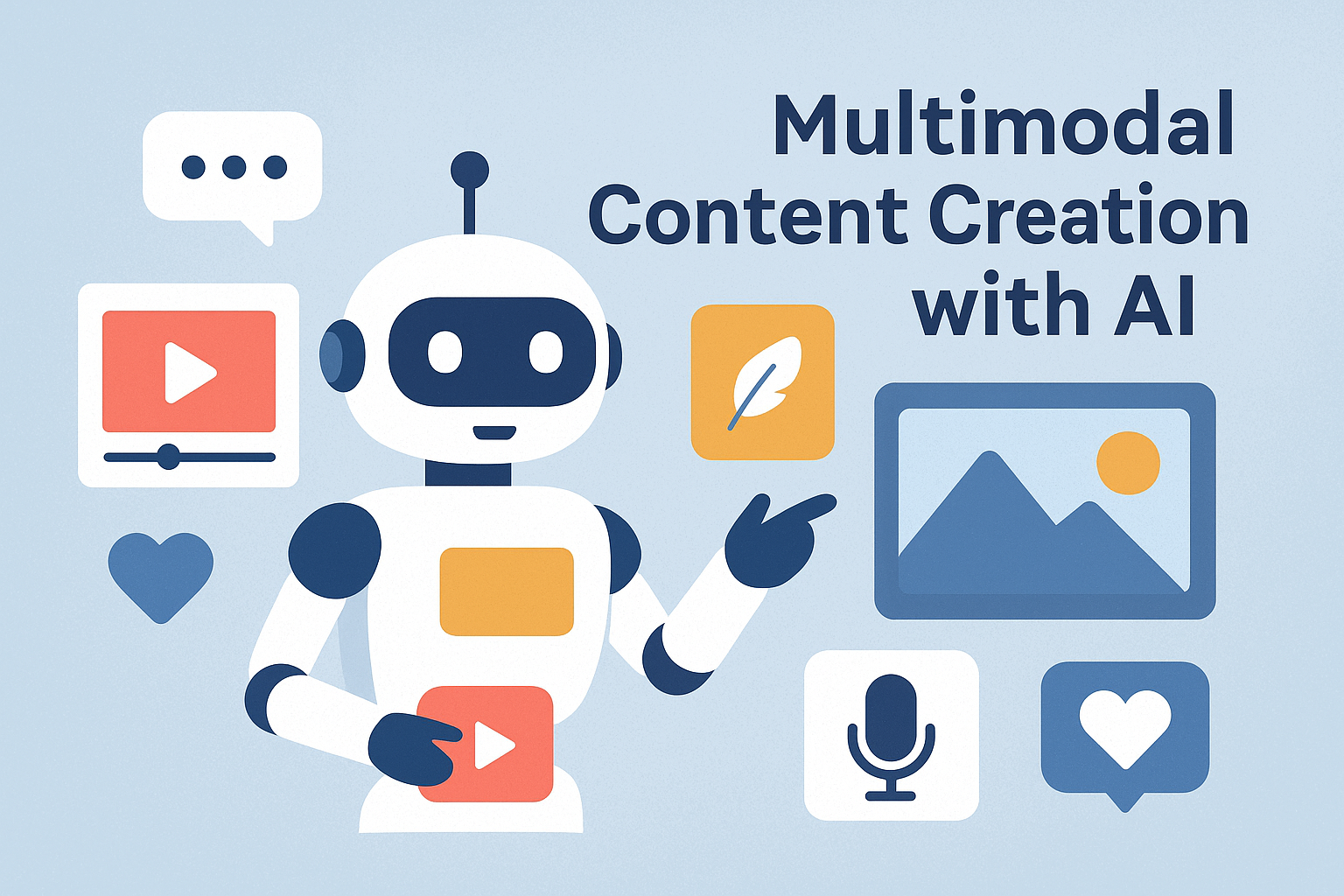
The rise of multimodal content creation is transforming how brands and creators produce and publish on social media in 2025. With new AI tools that generate text, images, video, and even audio from a single prompt, content production has never been faster or more unified. Moreover, this trend allows teams to maintain consistency across all platforms.
This AI-driven multimodal content creation trend isn’t just about convenience. In fact, it is changing how teams collaborate, how stories are told, and how audiences experience content across platforms.
What Multimodal Content Creation Means
“Multimodal” refers to combining multiple content types — text, visuals, audio, and motion — into one cohesive narrative. In 2025, AI platforms can now generate all of these elements in one workflow.
- Unified Storytelling: A single idea can instantly become a caption, image, and short video. As a result, creative campaigns move faster.
- Cross-Platform Consistency: The same concept adapts seamlessly for Instagram, TikTok, LinkedIn, and YouTube.
- Reduced Production Time: Campaigns that once took days can now be created in hours.
- Creative Expansion: Teams can experiment freely without the high cost of production.
Therefore, the result is an entirely new rhythm for digital storytelling — faster, more consistent, and deeply data-driven.
How AI Powers Multimodal Content Creation
AI tools such as video generators, caption writers, and design assistants now integrate into one ecosystem. Consequently, creators can move from concept to publication with almost no manual transfer between apps.
- Smart Prompting: Enter one description and receive text, visuals, and audio automatically.
- Adaptive Learning: AI refines outputs based on past performance and audience engagement. Furthermore, it predicts what will perform best.
- Automated Localization: Multilingual options let brands publish Arabic, English, or French versions instantly.
- Platform Optimization: AI adjusts formats, lengths, and ratios for each social network.
For example, agencies in the MENA region can now use a single creative brief to produce a full week of content across multiple languages and channels.
Benefits for Brands and Agencies
The multimodal content creation trend offers tangible strategic advantages for marketers worldwide.
- Efficiency: Smaller teams can now handle full-scale content pipelines.
- Creative Consistency: Visual tone and brand language stay unified across media.
- Scalability: Campaigns can be replicated for different markets without starting from zero. In addition, this saves significant resources.
- Accessibility: Even brands with limited budgets can compete on creative quality.
As a result, AI has turned content creation into a faster, smarter, and more collaborative process — where creativity and automation work hand in hand.
Challenges of Multimodal AI
The new power of multimodal creation also brings new responsibilities.
- Quality Control: AI output still needs human editing to preserve tone and accuracy.
- Ethical Use: Audiences expect transparency about AI involvement.
- Creative Dependence: Overreliance on automation can reduce originality if unchecked.
Therefore, to stay authentic, brands must combine AI efficiency with human insight — not replace it.
The Future of Social Content
Multimodal content creation is setting the standard for how social media will evolve beyond 2025. Moreover, AI is now a full creative partner, not just a background tool.
Agencies that embrace this shift early — especially in fast-moving markets like MENA — will lead a new era of social storytelling: one where a single idea becomes a living campaign across every platform.